During my first 50-plus years on the planet, I lived in the suburbs, commuted about 30 miles to work, and rarely participated in my community. We would participate in various activities at church, such as soccer and volleyball, and attend bake sales, among others. However, I don’t think I ever actually made a meaningful difference in my community. I think that describes most of us. I’m not saying that’s good or bad, but that’s how things are for most people living the 9 to 5 life. They are on a crazy schedule involving work and kids that starts when the alarm goes off and ends about the time Wheel of Fortune comes on. Meanwhile, everything seems to be running smoothly in the community. The usual group of town elders is running things. The same mom organizes the bake sales. And we go about our business.
If you get a chance to step off the hamster wheel, like many of us did with covid, we found ourselves in a strange remote land – our community.
Let Me In
Whether you are brand new to a community or you have lived there 20 years, there is a hierarchy, a group, and you probably aren’t part of it. Things are done a certain way, and they like it that way. Don’t get me wrong, they are probably doing a great job of keeping the lights on and programs working. They know things by heart, and they don’t even need to write them down (job security). Towns are always looking for volunteers to work on things, but there’s often an unwritten rule – don’t change anything.
A couple of years into being remote, we decided to downsize and move closer to the kids. We didn’t know the area and bought a home in a community where we knew no one. I had a little extra time since I wasn’t commuting anymore, and I had some ideas about how the town could attract others like me, so I joined a committee.
My first year on the Cultural Council, I learned how the sausage was made. Running any group in a small town is surprisingly difficult. Kudos to anyone who takes on the task. I’ve worked at the state and federal levels of government for 40 years, and local government is actually harder. The reason is that the government doesn’t scale down well. Once you get below a population of 10,000, the amount of paperwork doesn’t really change. You just have fewer people to do the same amount of work. Your operating costs are proportionately higher, and it’s hard to get people to do the work. But that’s another article. The bottom line is that people struggle just to get the basics done, and having someone show up with a bunch of new ideas almost seems like adding insult to injury.
Getting Comfortable with Change
The second year, I pushed the envelope gently. We added a small celebration for our grant recipients. We had a small turnout, but it was well-received. The group got comfortable with it and now it’s part of the regular process. Then I went too far and proposed a music festival. We had no money, no one had done anything like this (including me), and people didn’t have the bandwidth to dedicate to it. All valid reasons not to do it.
Everyone was comfortable with the idea itself, but didn’t really have the time to dedicate to it. I got the necessary approvals, but I was more or less on my own for the heavy lifting. Existing committee members helped where they could, but I really had to look outside the existing structure to get help. I posted a couple of planning events on Facebook, and several people joined in to help out.
At the end of the day, we didn’t get any of the grants we applied for, and only raised about enough money for a large HD TV. We were still unsure of all the venues a week before the planned event because of some permitting issues. And we actually replaced one of the performers who got injured with 2 hours’ notice. We had more people in the downtown area than when they did the 250th Anniversary of the town. And for a lot of people, I think it was a lightbulb moment of “Oh – this is possible”.
Discovering Connections
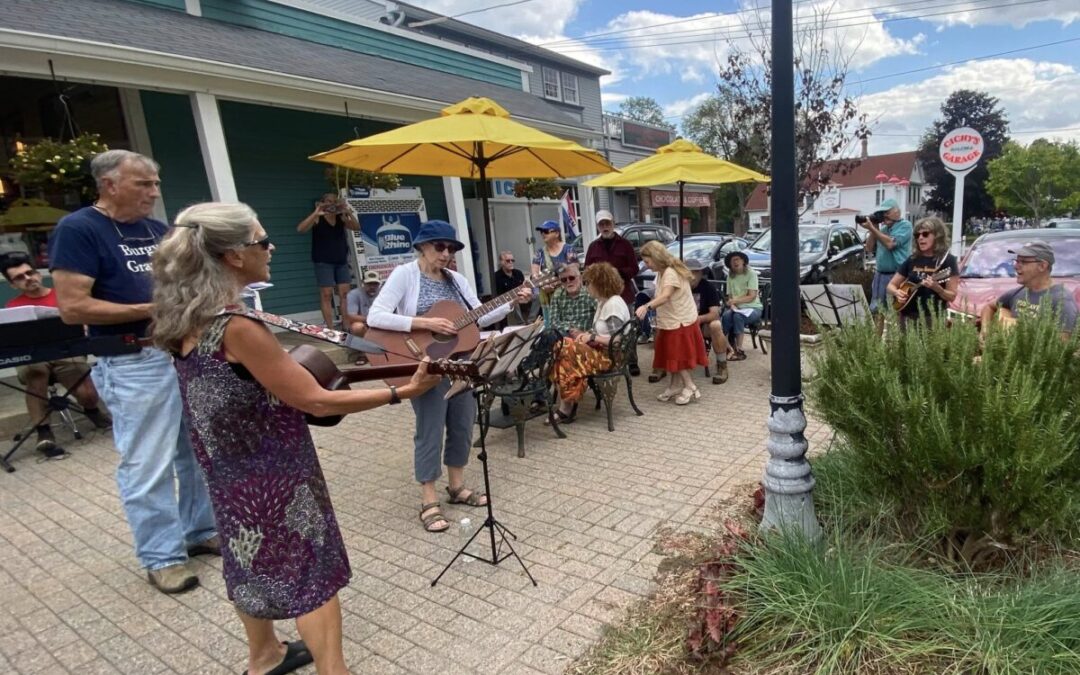
One of the things I’ve discovered about being remote is that people need ways and places to connect. In a town without a lot of community spaces, events are a great way to bring people together. If it’s done well, it’s already special. Then it’s just a matter of making those connections. We had 10 musical acts, and some performers travelled over 100 miles to perform, just to be part of the event. One performer (and she insisted she wasn’t a performer) organized a sing-along. She had 50 people singing songs with her, and many brought their own instruments. It was probably the most connected hour of the day.
As the day progressed, I got to see less and less of the actual performances. People were stopping me to talk about the event, life, community, and the combination of art/music/dance, etc. 90% of them I had never met before. And I was so fried, I just told people to go on the website and email me so I had their information. I remember a few names, but most of it was a blur.
One of the more interesting interactions was after it was over, I needed something quick at the market before I went home to pass out. Rewind a bit. Around lunch time, my wife had gone to get me a sandwich at the market. (I ended up walking around with it for almost an hour before actually having a break to eat it. ) As I walked into the market at closing time, a guy who works in the deli area, whom I don’t think I’ve ever had a conversation with, says, “How was the sandwich?”
I let him know it was really good. It reminded me of one of the janitors for the Apollo program being asked what his job was, and he responded something to the effect, “I’m helping put a man on the moon.” Now this wasn’t exactly a moon shot, but for a small town, this was a big deal. A sandwich from the Williamsburg Market, was one of many elements that helped bring a community together and make it a great day. If you are wondering, the second annual Williamsburg Porchfest is already scheduled for September 12, 2026.