
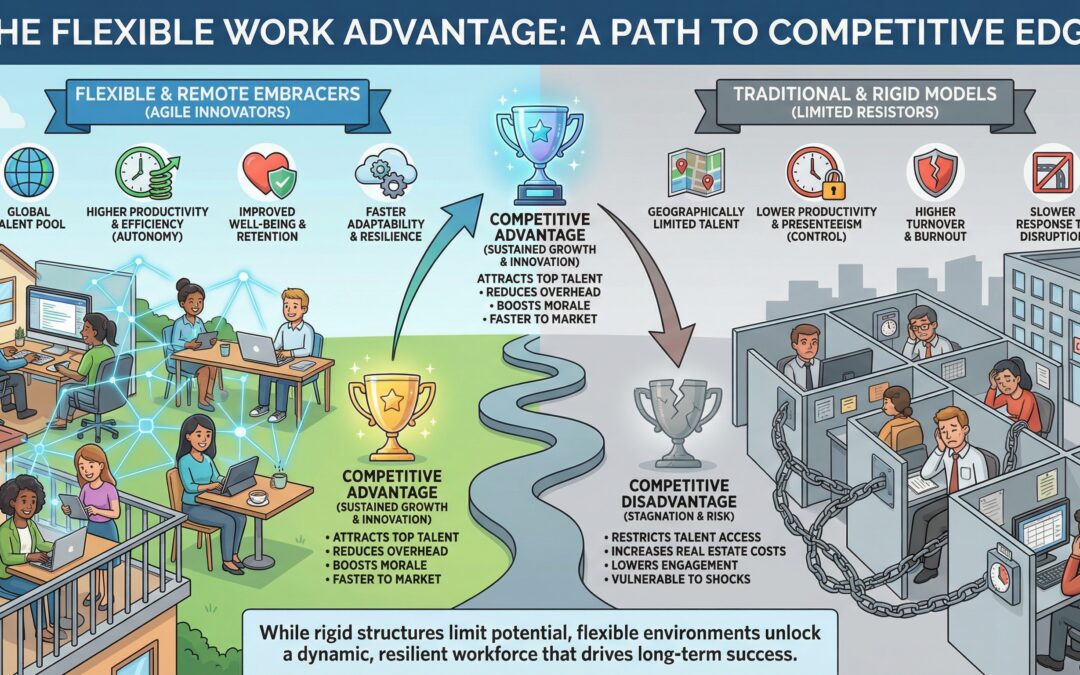
Flexible work is the new direction for most companies. When people work is actually valued more than where people work. Most companies have been struggling with hybrid work since they started. It’s not that there is anything wrong with hybrid work, but it was always sort of like using a knife as a screwdriver. It works depending on the situation, bit it doesn’t always do what you want, and most of the time you end up ruining the knife over time. I’ve stretched the metaphor a bit, but the same thing happened within lots of companies. They weren’t really set up for hybrid operations, but they adapted with what they had. Sometimes it worked, and sometimes it didn’t. The key to success generally revolved around what organizations were willing to let go of in terms of existing structures.
The Office Assumption
What’s the difference between a 20-year-old company and a startup? Chances are, the new company doesn’t have an office yet. Or at least they haven’t made a long-term investment in space. For some reason, people view marriages as less permanent than offices. You can always get another spouse, but an office should be forever. Sounds silly when you think about it, but that’s the message that many companies put out there. You can do whatever it takes to get the job done, just make sure you leverage our investment in the office.
Adapting to Change
Every change management project I have been involved in that failed had a common element. There was at least one thing we were not allowed to change. Years ago, I worked with a woman who was a secretary. She loved her job and refused to retire until she was well into her 80s. The problem was that her job description was written some time around when I was born, and desktop computers hadn’t been invented yet. (Kennedy may have been President) And that was just the way she liked it. Every time a supervisor tried to get her to switch, she refused. If they kept pushing, she would file a grievance with the union and win. As a result, the agency maintained over 300 paper forms well into this century. When she finally retired, there was a nice cake around lunchtime, and she said her goodbyes. A few minutes after her car left the parking lot, her boss came down the stairs with her IBM Selectric typewriter. He took it outside and smashed it in the dumpster. Getting rid of the 300 paper forms took a bit longer.
They say that change takes time, but in reality, change happens in an instant. You just need a catalyzing moment and the right framework for people embrace. Most people never really understood what hybrid was.
What Type of Hybrid?
If you ask 10 CEOs what hybrid means, you are likely to get at least as many answers. Even among workplace professionals, there is no common definition for hybrid. In many ways, hybrid is a continuum between 100% in office and 100% remote. The question is where the rules come from. Most companies that struggle try to make office rules work outside the office. I tend to promote a remote-first strategy where processes need to work for everyone, wherever they are.
Where most companies mess up hybrid is that they give individuals options on how they are going to implement it. Figure out the schedule that works for you based on some formula (1 day a week, 2 days a week, etc.) This rarely has anything to do with how work gets done. Companies that have been successful with hybrid have planned in terms of teams, not individuals.
One of the offices I support, I have only been into twice in 5 years. Both times, most of the people I would have liked to meet with were working remote, so I got to do Teams meetings from the office. I also had to keep standing up and waving my hands because the lights have motion sensors. They kept turning off because there was not enough movement in the building. And don’t get me started on HVAC systems that don’t account for the reduced occupancy.
A Problem of Language
Ultimately, hybrid fails as a concept because there isn’t a common definition. For years, I’ve worked on a government program which had had a loosely defined interface requirement. The standard lets everyone be compliant, but there are still instances where compliant systems can’t easily talk to one another. Luckily, this is getting better, and we are getting closer to plug and play. Hybrid, as a concept, has no shepherd to steer it in a specific direction. Some organizations will succeed with it, and others will fail. They both say they are doing the same thing, but what they are doing is very different.
Flexibility, on the other hand, has an underlying common definition and understanding. It might not be any better than hybrid at describing exactly what is happening, but there is a significant conceptual difference. Flexibility implies different ways to do things. Hybrid often is limited to defining where and when things get done, but it often misses out on the how or when.
Flexibility also starts extending into business continuity issues. Hybrid focuses on whether you are in the office or out of the office and when. Flexibility takes into consideration whether the office is accessible or functional. How many days you are in the office is a moot point if the first floor is flooded and all the windows are blown out in a hurricane. Flexibility takes a larger view of the situation. It also has some basic unwritten rules that everyone can understand. A 6-year-old understands the difference between flexible and rigid.
Getting Closer to Understanding
Probably the main differentiator is viewing the office as a tool to be used as needed, not a resource to get the most out of because of the existing investment. Flexible companies aren’t tied to their offices. They are more likely to right-size them rather than trying to make the existing structure work.
Overall, I think flexibility is the easier sell to both management and staff. It requires less explanation, and it implies trust. That’s always a good way to start things off. I think it’s one step closer to us all speaking the same language when it comes to the future of work.