
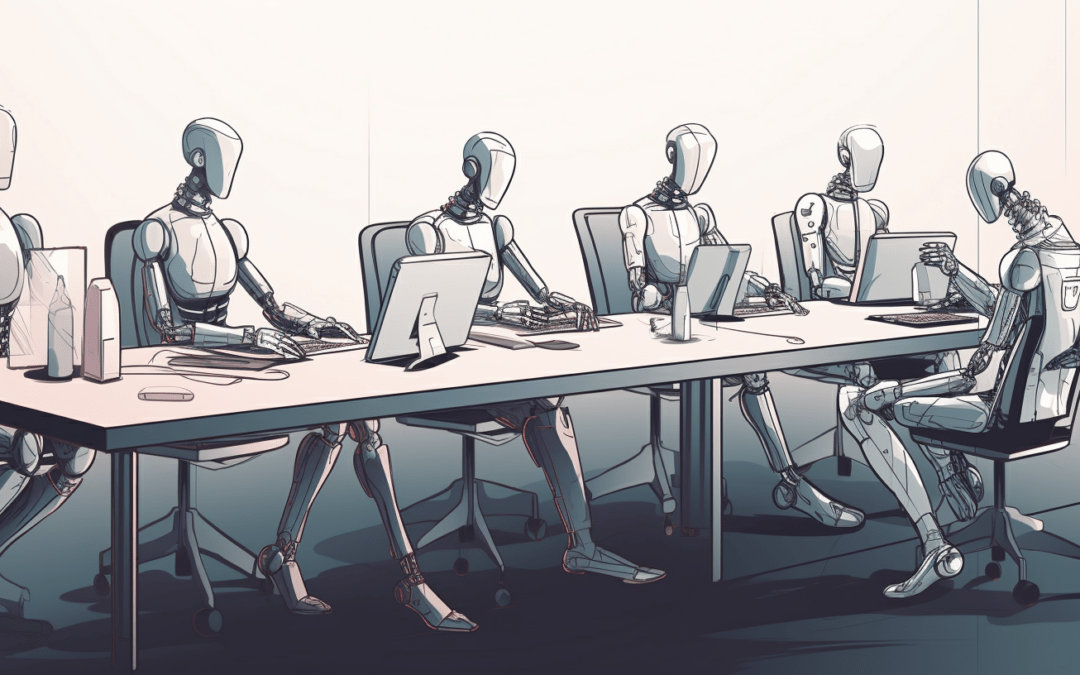
For more than a century, the office has symbolized productivity, collaboration, and career growth. Yet even before the global shift triggered by the COVID-19 pandemic, the traditional office model was already under pressure. Advances in digital communication, cloud computing, and mobile technology made remote and hybrid work increasingly viable. Now, the rapid acceleration of artificial intelligence (AI) is reshaping that evolution yet again—pushing the workplace even further from the physical office and closer to a distributed, automated, and highly flexible future.
AI is not merely enabling employees to work from anywhere. It is redefining what work needs to be done by humans at all in a centralized location. As AI capabilities expand, companies are rethinking the purpose of office space, the necessity of co-location, and the structure of teams. The result is a profound shift in the office’s role. Fewer workers will need to be in an office, not because of short-term disruptions, but because AI will fundamentally transform how we communicate, collaborate, and create value.
Automation of Routine Office Tasks
A major reason workers were historically brought together in offices was to perform routine, repetitive tasks that required human attention and oversight. There was/is a general lack of trust in the system. Management was there to make sure workers met quotas, didn’t slack off, etc.
Today, AI handles an increasing share of these tasks with greater speed and accuracy. AI systems now process invoices, sort emails, audit expense reports, analyze spreadsheets, route customer inquiries, and even draft legal documents—all tasks once done by teams of employees. Many companies would view this as an opportunity to replace people. But what they should be doing is replacing/rethinking processes.
With routine tasks automated, employees increasingly focus on higher-level strategic or creative work, much of which does not require physical presence. Because AI tools can operate in the cloud, workers can collaborate with them from anywhere. This shift decouples productivity from a physical location and reduces the rationale for centralized offices full of administrative staff. This also means a new role for traditional managers.
Smarter Collaboration Tools That Replace In-Person Meetings
Early remote-work tools, such as email and basic video conferencing, were often seen as imperfect substitutes for in-person collaboration. AI, however, is closing that gap rapidly. Today’s AI-enhanced platforms can:
- transcribe meetings in real time,
- generate summaries and action items,
- translate speech across languages instantly,
- analyze tone and engagement,
- manage scheduling across global time zones,
- and even simulate whiteboard sessions with smart suggestions.
These features make virtual collaboration not just comparable to in-person work but often better, more efficient, and more inclusive. When AI reliably captures all insights and eliminates communication friction, the need for everyone to gather physically diminishes. Companies that once relied on face-to-face meetings for decision-making can now leverage AI to ensure clarity and alignment without requiring employees to commute.
Technology isn’t the hard part. What is difficult is letting go of what you know. People will always gravitate to what they are most familiar with. This is why we are seeing the managerial pushback with Return to Office Mandates (RTO). They don’t work, and there is plenty of research to show that it actually hurts the bottom line. Still, people hold on to what they are most comfortable with, even if it hurts them.
AI-Driven Project Management and Oversight
Managers have traditionally felt the need to be physically present to monitor progress, review work, and provide real-time guidance. Again, all tied to a lack of trust. AI is breaking that dependence. Modern AI systems can track productivity, detect workflow bottlenecks, predict delays, analyze workload distribution, and surface insights long before human managers might notice problem areas.
This doesn’t replace the human leader; instead, it equips them with rich data and automated oversight that allows effective management from anywhere. As AI provides visibility into team performance and project status, the perceived need for managers and staff to share the same physical environment weakens. Management becomes more about coaching and decision-making—not about watching over people in an office. Unfortunately, these are skills that many current managers don’t have. This is a key problem leaders need to address if they are going to be successful with their AI implementation.
AI as a Virtual Coworker and Skill Accelerator
AI increasingly acts as a “virtual coworker,” assisting with tasks once requiring in-person expertise. Note, I said “assisting”, not “replacing”. Personal computers and global outsourcing are two trends that leaders thought were going to replace large groups of workers. Those who cut first and asked questions later eventually realized they still needed people, just with different skills. Retrain versus replace is the mantra that should accompany AI rollout as well.
AI tools can help write code, design presentations, conduct research, brainstorm marketing copy, or analyze complex datasets. Employees who once needed to collaborate closely with specialized colleagues in an office can now rely on AI to augment their skills, reducing dependency on physical proximity to experts.
Additionally, AI serves as an on-demand learning system, guiding workers through unfamiliar tasks with step-by-step instructions tailored to their skill level. This supports a distributed workforce because employees do not need an on-site mentor or supervisor to provide training or troubleshoot in real time. Leaders again need to rethink the role of supervisors to make the transition smooth. With AI assistance, individuals can become more self-sufficient and effective in remote settings.
Enhanced Cybersecurity Enables Distributed Work
Another traditional justification for office-centric work has been security. Sensitive data, proprietary information, and mission-critical systems were often safer within controlled corporate environments. AI-powered cybersecurity challenges that assumption. AI systems can detect anomalies, flag suspicious behavior, prevent phishing attacks, and respond to threats within milliseconds—far faster than human teams could.
Because security no longer depends on physical presence but on intelligent systems, organizations can confidently allow employees to work from anywhere without increasing risk. AI makes distributed work not only possible but secure.
AI’s Influence on Corporate Real Estate and Cost Strategy
As AI reduces reliance on administrative staff, streamlines workflows, and supports remote operations, companies are questioning the value of maintaining large office complexes. Many leaders use the argument that they need to maximize their use of existing resources to force people back into the office. This is a flawed argument. When your kids move out of your house, you don’t try to force them back or get more kids. Most people downsize. Organizations should adopt the same approach. Commercial real estate is expensive, and CFOs increasingly consider office space a variable cost rather than a fixed necessity. AI-enabled remote teams provide:
- lower overhead costs,
- reduced need for physical meeting rooms,
- fewer desks and offices,
- and opportunities to hire talent globally rather than locally.
This financial incentive accelerates the move toward hybrid and virtual workplaces, further diminishing the need for employees to return to traditional offices.
Cultural Shifts Driven by AI Adoption
One of the most powerful effects of AI is cultural rather than technological. As teams grow accustomed to collaborating with AI tools and coworkers in different locations, norms shift. We aren’t just adding more automation to existing tasks. We are changing the way we do things. The idea that productivity requires colocation becomes outdated. Culture evolves toward outcomes, flexibility, and autonomy rather than hours spent in a building. There needs to be a compelling business case for being in a building. Access to tools, security requirements, customer access, and special events are all reasons for working in the same space.
Younger generations, already comfortable with digital workflows, see AI as an enabler of freedom and efficiency. As these workers become the majority, the pressure to abandon outdated office norms grows stronger.
The Office Will Evolve, Not Disappear
The rise of AI does not mean the end of offices—but it will redefine their purpose. The sooner we start thinking that way, the sooner our AI implementation will start bearing fruit. AI will eventually pull us in that direction, but we will get there faster if we lead the way. Rather than being the default location of work, offices will become occasional gathering spots for brainstorming, relationship building, and cultural cohesion.
AI is accelerating this shift by automating routine work, enhancing virtual collaboration, expanding remote management capabilities, and enabling secure, distributed teams. The result is clear: fewer workers will need to be in the office, not because companies want to cut costs, but because AI makes location less relevant to productivity and success.
In the years ahead, the question will no longer be “How can we bring people back to the office?” but rather “How do we design work, and a workplace—physical or digital—that best leverages AI and human talent together?”
Here’s a free checklist to help you get started.