Something remarkable is happening right now. While tech companies race to develop the next breakthrough in artificial intelligence and virtual reality, a growing number of people are doing something unexpected—they’re unplugging. They’re trading their smartphones for pocket notebooks, their streaming services for concert tickets, and their online communities for neighborhood gatherings. Welcome to 2026, the year many are calling the Year of Analog.
This isn’t about rejecting technology entirely. Instead, it’s a thoughtful recalibration of how we interact with the world around us. People are rediscovering the tactile pleasure of writing with pen and paper, the irreplaceable energy of live performances, and the warmth of genuine human connection. At the same time, they’re questioning whether our headlong rush into an AI-dominated future is really taking us where we want to go.
Companies that dove straight into the deep end of the AI pool are finding that almost 40% of the time saving is lost fixing things. It does make you take a step back and re-evaluate things. My personal experience is that you really have to experiment before making an AI commitment. I’ve found that Claude is much better than ChatGPT for some of the things I do. And Perplexity is better than both for research-related tasks. For business related images, imagegen.ai is really impressive – but it is dependent on the subject. But as Bill Gates said many years ago, “Sometimes, a pencil is the right tool”.
Discovering Analog through Remote Work
When you aren’t in a sterile cubicle farm and have choices of your surroundings, I think you notice them more. You start paying attention to sights, sounds, smells, etc., and how you interact with them. For many, it starts with a rediscovery of vinyl. Sure, you can stream millions of songs for one low price, but you can’t touch it. In 2006 less than 1 million records were sold. Last year, 43.6 million records were sold.
And what about that loaf of white bread you picked up at the store last whenever. It probably hasn’t gone bad yet, thanks to all the preservatives. I’m not sure the exact connection between Covid and Sourdough, but it happened. And it’s not going away. People have rediscovered the art of bread making, and pasta making, among other things. My new pasta maker (old school with the crank), is still waiting for a test drive, but it’s just a matter of time. The call is strong.
A New Lens
Remote work gives us time to look at things differently and rediscover things that might be part of our culture, but we may not have experienced ourselves. While it might be faster and more efficient to use computers to compose things, our brains function differently when we write things out by hand. Journals had a boom during the covid era, dropped a bit and are on the rise again – no pun intended.
The analog movement represents a conscious choice to prioritize physical, tangible experiences over digital ones. It’s about selecting a paperback book over an e-reader, attending a live concert instead of watching a livestream, or having coffee with a friend rather than messaging them. This shift isn’t driven by technophobia but by a desire for deeper, more meaningful engagement with life.
Think of it as a cultural correction. After years of increasingly digital existence—accelerated dramatically by the pandemic—we’re collectively realizing that something essential has been lost. The analog movement seeks to reclaim that something: presence, authenticity, and human connection.
The Analog Office
This isn’t the first time society has pushed back against technological advancement. The Arts and Crafts movement of the late 1800s emerged as a reaction to industrial mass production. In the 1960s and 70s, the back-to-the-land movement saw people leaving cities for rural communes.
What makes 2026’s analog renaissance different is its scale and the specific technologies being reconsidered. We’re not just questioning industrial processes or music formats—we’re questioning the fundamental architecture of how we work, communicate, create, and think.
For organizations that are doing it right, that means not just trying to plug people into the existing office they have. It’s about figuring out what type of infrastructure is needed going forward for work to take place. Chances are that isn’t going to mean a new color for the cubicle or faster internet. It is likely to be less dedicated traditional work space, more collaboration space, and specialty spaces for things like video production, 3D printing, It’s also likely to mean less overall centralized space usage. This means letting go of everything that had to be a certain way prior to 2020. Look for the best of digital to form the foundation, but expect a new analog layer to fit nicely over the top.
What’s Old is New Again
Whether you’ve just bought a flip phone, a journal to write in, or the White Album for the second time, these things are changing us. We’ve embraced technology, gotten over the newness, and are now figuring out where it fits in our world. I think when we got fully consumed by commuter culture, we forgot about many things.
Forty years ago, when I was in college, Kate Bush’s Running Up That Hill was released. It hit #3 on the British charts but went relatively unnoticed in the U.S. Then, in 2022, it completely blew up as part of Stranger Things Season 4. It’s interesting to see how it resonates with people today. I always thought Kate was ahead of her time, but I think there’s more to it than that.
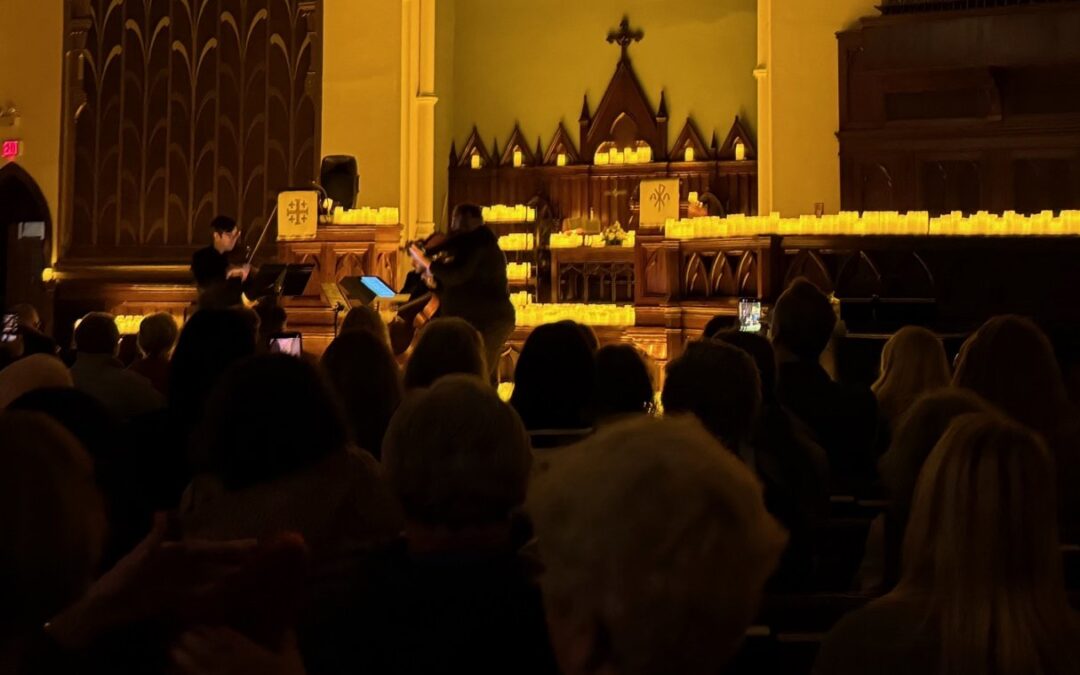
The other night we went to a trio (two violins and a cello) performing the music of Coldplay. It was done in an old church. There was no amplification. And there was no lighting. It was all candles – 1000 of them. What could be simpler? Now here’s the cool part. Streaming media continues to dilute what musicians make. I know one musician who has had over a million views on YouTube. Unfortunately, this translates to pennies per month. Alternatively, this old school concert in the dark is not only affordable for audiences, it’s surprisingly profitable for musicians. And most importantly, it’s pretty cool.
I’m seeing this step back from technology in many places. You don’t have to look far to see it. If you are a Star Trek fan, it was a theme in more than one episode. I think it is probably just part of our evolution as humans. We work to develop technology, and in turn find our own humanity.